

Python & AI: How One Language Connects Generative AI, Agents, LLMs, and RAG
Generative AI vs AI Agent vs LLM vs RAG: A Simple Guide for Everyone

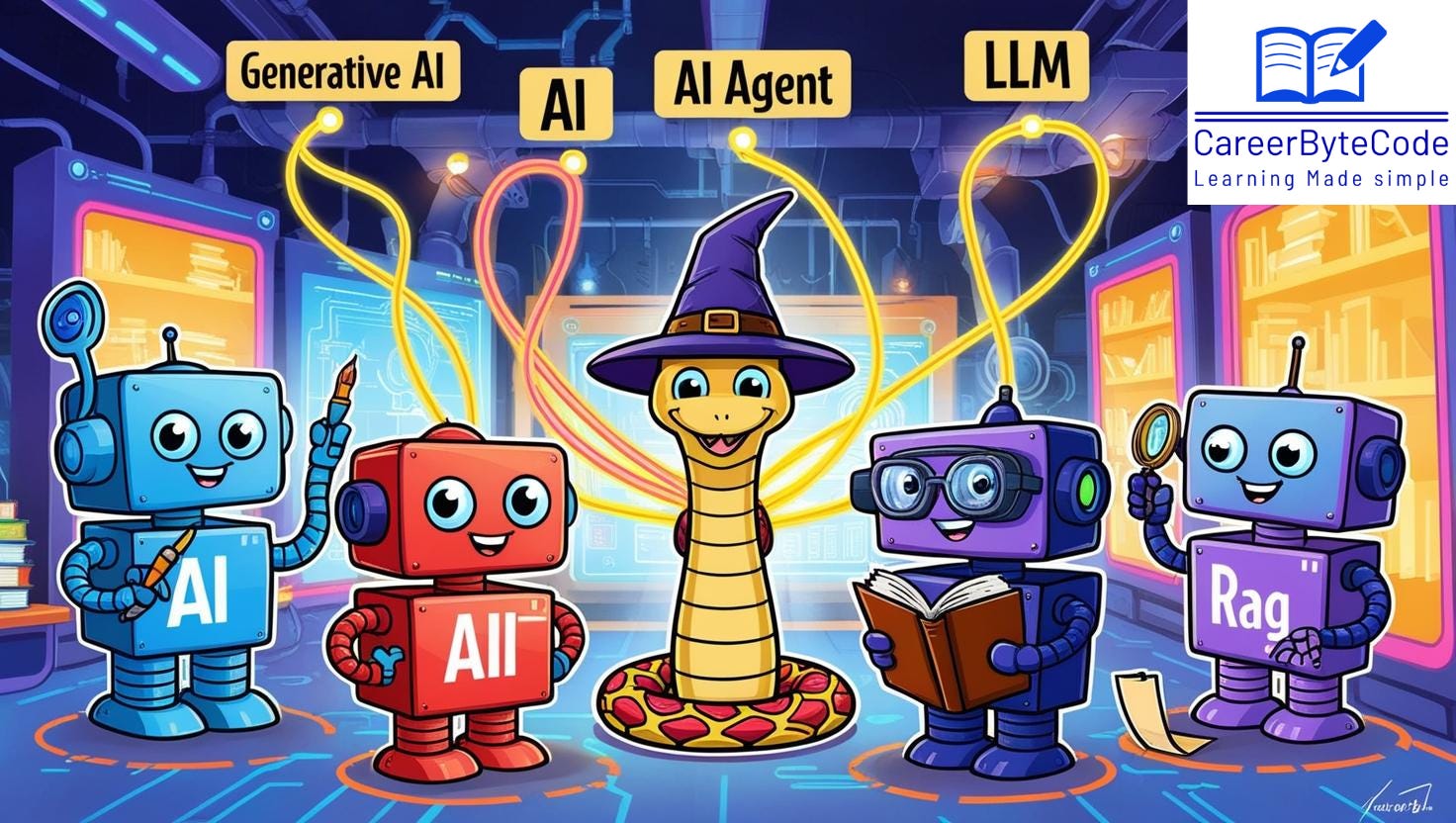
The AI world is growing fast. New words show up every day—Generative AI, AI Agent, LLM, and RAG. These terms can feel confusing. But when broken down, they’re easy to understand.
This article gives clear meaning to each term with 5 real-world examples. You’ll also learn how Python connects all of them.
Generative AI: The Creator
Generative AI builds something new. It doesn’t just repeat what it knows. It creates fresh content—text, images, code, or music—based on the data it has learned from.
5 Real-Life Examples of Generative AI
Email Writer
You give a few points. It writes a full email for you.Image Maker
You say, “A panda reading a book,” and it draws it.Code Helper
You describe a task. It writes Python code that works.Music Generator
It creates a soft tune based on your mood.Story Builder
It takes a story title and writes a full short story.
AI Agent: The Doer
An AI Agent goes beyond writing or replying. It can plan, make choices, and take action. It works toward a goal.
5 Real-Life Examples of AI Agents
Meeting Scheduler
It reads your calendar and books slots.Support Assistant
It chats with users and solves their issues.Email Sorter
It checks your inbox and moves emails to folders.Smart Thermostat
It adjusts room temperature when you leave home.Code Tester
It tests software, finds errors, and logs them.
LLM: The Brain
LLM means Large Language Model. It is a model trained on tons of text. It understands human language and can reply in a smart way.
LLMs are the engine behind many Generative AI tools. They don't just copy—they predict and create.
5 Real-Life Examples of LLMs
Chatbots
You ask a question. It gives a smart, human-like answer.Language Translators
Converts English to other languages in seconds.Grammar Tools
Fixes mistakes and rewrites your sentence better.Summarizers
Turns long content into short notes.Interview Prep Tools
Asks you real questions and answers them for practice.
RAG: The Researcher
RAG stands for Retrieval-Augmented Generation. It combines search with smart answers. First, it finds the right facts. Then it writes the answer using those facts.
5 Real-Life Examples of RAG
PDF Q&A Bot
You ask a question. It searches your PDF and answers it.Helpdesk Assistant
Answers employee questions using company files.Legal Research Tool
Reads through thousands of legal pages and explains laws.Custom Chatbots
You upload your own data. It only uses that data to answer.Smart Search Chat
It browses online and gives real-time answers.
Why Python Matters for All of These
Python is the most used language in AI. It is easy to read, powerful, and has many tools. Here’s how Python helps each AI type:
Generative AI
Python lets you build or use tools that create text, images, and code.
Libraries like
transformersanddiffusersmake it simple.
AI Agents
Python helps define logic and workflows.
You can use
LangChainto build goal-driven agents.
LLMs
LLMs are trained and used with Python tools.
You can load models like GPT, BERT, or LLaMA with a few lines of Python.
RAG
RAG uses Python to connect search tools (like
FAISS) with language tools (like GPT).Frameworks like
HaystackandLangChainuse Python at their core.
Wrap-Up: Simple Words, Big Impact
Let’s break it down:
Generative AI builds new things.
AI Agent takes smart actions.
LLM understands and talks like a human.
RAG finds facts before it speaks.
And Python is the thread that ties all of them together.
Learning Python gives you a strong start in any AI field. Whether you're building smart tools or just getting started, Python makes it all possible.
Why You Should Learn Python (And How It Helps You in AI)
Python isn’t just a programming language—it’s the foundation of modern AI.
If you're stepping into the world of AI, Python is your first and smartest step.
🔹 1. Python is Beginner-Friendly
Simple Syntax: Python reads like plain English. Even if you're new to coding, you can quickly grasp the basics.
Huge Community Support: Got a question? Chances are someone has already answered it. Python has one of the largest support communities out there.
Tons of Learning Resources: From free tutorials to YouTube series to hands-on projects, there’s something for every learning style.
🧠 If you can read and write basic English, you can learn Python.
🔹 2. Python Powers All the AI Domains
Let’s look at how Python directly supports each AI concept:
🧠 Generative AI (The Creator)
Want to create text, images, or even music with AI?
✅ Python gives you access to powerful libraries like:
transformers(from Hugging Face) – For text generationdiffusers– For image generation (like DALL·E or Stable Diffusion)music21– For AI-based music composition
📌 Use Case: Generate blog posts, memes, YouTube scripts, or code with just a few lines of Python.
⚙️ AI Agents (The Doer)
Want an AI that books meetings, sorts emails, or runs tasks?
✅ Python enables:
Workflow building tools like LangChain and AgentHub
Automation libraries like Python’s
os,shutil, andsubprocessTask handling with frameworks like Airflow or Celery
📌 Use Case: Build your own custom assistant that plans your day, filters your inbox, or auto-generates reports.
💡 LLMs (The Brain)
Want to create smart chatbots or language tools?
✅ Python helps you:
Load LLMs (like GPT, BERT, or LLaMA) using just a few commands.
Build custom chatbots using Gradio, Streamlit, or FastAPI.
Integrate LLMs into real-world products using Python SDKs and APIs.
📌 Use Case: Build a resume checker, grammar fixer, or virtual tutor—using open-source models.
🔍 RAG (The Researcher)
Want smarter AI that uses your documents to answer questions?
✅ Python lets you:
Use FAISS for vector search.
Integrate LLMs with retrieval using LangChain or Haystack.
Upload and index your own files like PDFs, Word docs, or Notion pages.
📌 Use Case: Create your own private ChatGPT that only answers based on your company files or personal notes.
🔹 3. Python Helps You Land AI Jobs
90% of AI jobs mention Python as a requirement.
It’s the default language for AI courses, bootcamps, and research papers.
Whether you're a developer, analyst, researcher, or enthusiast—Python is the common ground.
🔹 4. Python is Future-Proof
AI, DevOps, Automation, Data Science, Cloud—you name it—Python is everywhere.
When you learn Python, you’re not just preparing for one role. You're equipping yourself for every evolving tech role in the future.
Final Thought
Learning Python is like learning to ride a bicycle in the AI world.
Once you know it, the rest becomes much easier.
🚀 Whether you're exploring Generative AI, building smart agents, creating your own chatbot, or building a RAG-powered assistant—Python is the engine behind the scenes.
Start small. Stay consistent. Build amazing things with Python.