

Hosting a Static Website on Amazon S3 with Secure Access
Amazon S3 (Simple Storage Service) provides a reliable and scalable platform to host static websites such as HTML, CSS, and JavaScript files.


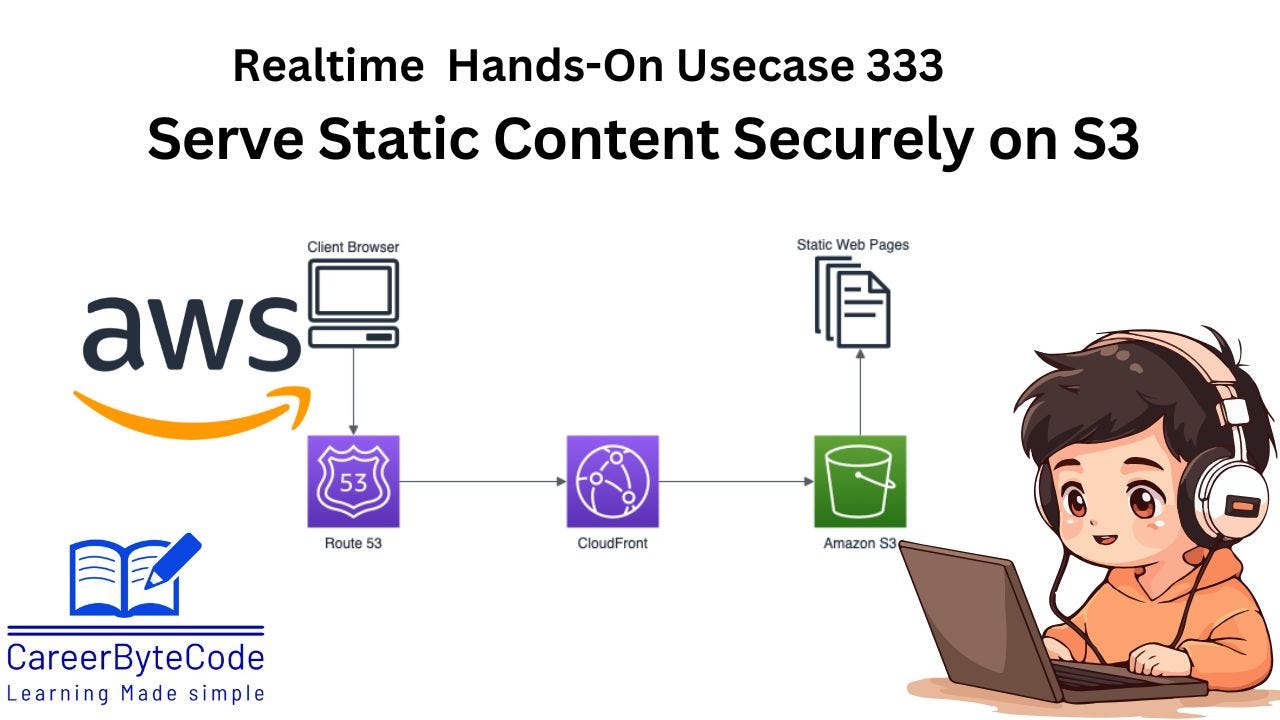
1. Problem Statement:
Modern web applications increasingly demand cost-effective, highly available, and globally accessible solutions for hosting static content such as personal websites, blogs, documentation, and front-end applications. Traditional web hosting approaches often involve managing web servers, configuring complex software stacks, and incurring high operational overhead—making them unsuitable for projects with limited resources or scalability requirements.
Amazon S3 (Simple Storage Service) offers a serverless, scalable alternative that enables users to host static websites with minimal configuration. However, while S3 is well-suited for storing and serving static files (HTML, CSS, JS), it introduces critical security and access management challenges when exposing buckets to the public:
Unrestricted Public Access Risks: Granting full public access to an S3 bucket can inadvertently expose sensitive files or open the door to malicious users modifying or deleting hosted content.
Lack of Granular Control: Users often struggle to strike a balance between making website files publicly readable and keeping other objects or operations (like uploads and deletions) secure.
Secure Integration with Other AWS Services: In real-world use cases, static websites may be part of a larger architecture that includes services like AWS Lambda (for processing form submissions), CloudFront (for CDN), or WAF (for filtering malicious traffic). Ensuring the correct flow of permissions between these services adds further complexity.
Compliance and Data Protection: Many businesses require fine-tuned access control to comply with data protection laws (like GDPR), which prohibit unrestricted access to user or configuration data.
Visibility and Debugging Issues: Misconfigured bucket policies can lead to inaccessible content or open vulnerabilities, and it’s often difficult for beginners to understand why access is denied or where security holes exist.
These problems necessitate a well-documented, secure, and easy-to-replicate approach to hosting static websites on Amazon S3 that:
Enables public read-only access to static website files.
Prevents unauthorized uploads, deletions, or overwrites.
Supports security controls such as IP whitelisting, CloudFront-only access, and authenticated user restrictions.
Is scalable and integrates with AWS best practices.
2. Why we need this use case:
Amazon S3 (Simple Storage Service) provides a reliable and scalable platform to host static websites such as HTML, CSS, and JavaScript files. It’s an excellent choice for static content hosting due to its high availability, low-cost storage, and integration with other AWS services. However, hosting static websites also requires careful management of access controls to ensure that your content is accessible to users while keeping your resources secure.
The need for secure access arises because exposing files on a website without proper permissions can lead to data breaches, unauthorized access, or accidental deletion. With a secure bucket policy, you can allow public access to your static website content (e.g., HTML, CSS, JavaScript) while ensuring that sensitive resources, such as private data or configuration files, remain protected.
This use case ensures that while your static website files are publicly accessible, unauthorized users cannot alter, upload, or delete files, providing a secure hosting environment for your static content.
3. When we need this use case:
Hosting Static Websites: If you need to host static websites (e.g., personal sites, blogs, documentation, portfolios) without managing complex infrastructure, S3 is a perfect fit.
Scalable and Cost-Effective: This use case is ideal for applications where cost-efficiency and scalability are essential, and you want a managed service to handle the hosting of static files without setting up web servers or CDN services manually.
Global Content Delivery: When content needs to be distributed globally with low latency, S3 offers an efficient solution when combined with AWS CloudFront for CDN functionality.
Security with Simple Access Control: For websites that require public access but need to maintain security by restricting write/delete permissions, a bucket policy helps manage access efficiently.
